Guide
How to start a moving-bin rental business
Start with a fleet of reusable bins, a vehicle you may already drive and one route day a week. Customers book online, you deliver the bins before their move and collect them about two weeks later, then wash them and rent them again. This guide covers the costs, the steps and the problems to plan for, from what MoverBins learned in Memphis.
By MoverBins · Updated
What is a moving-bin rental business?
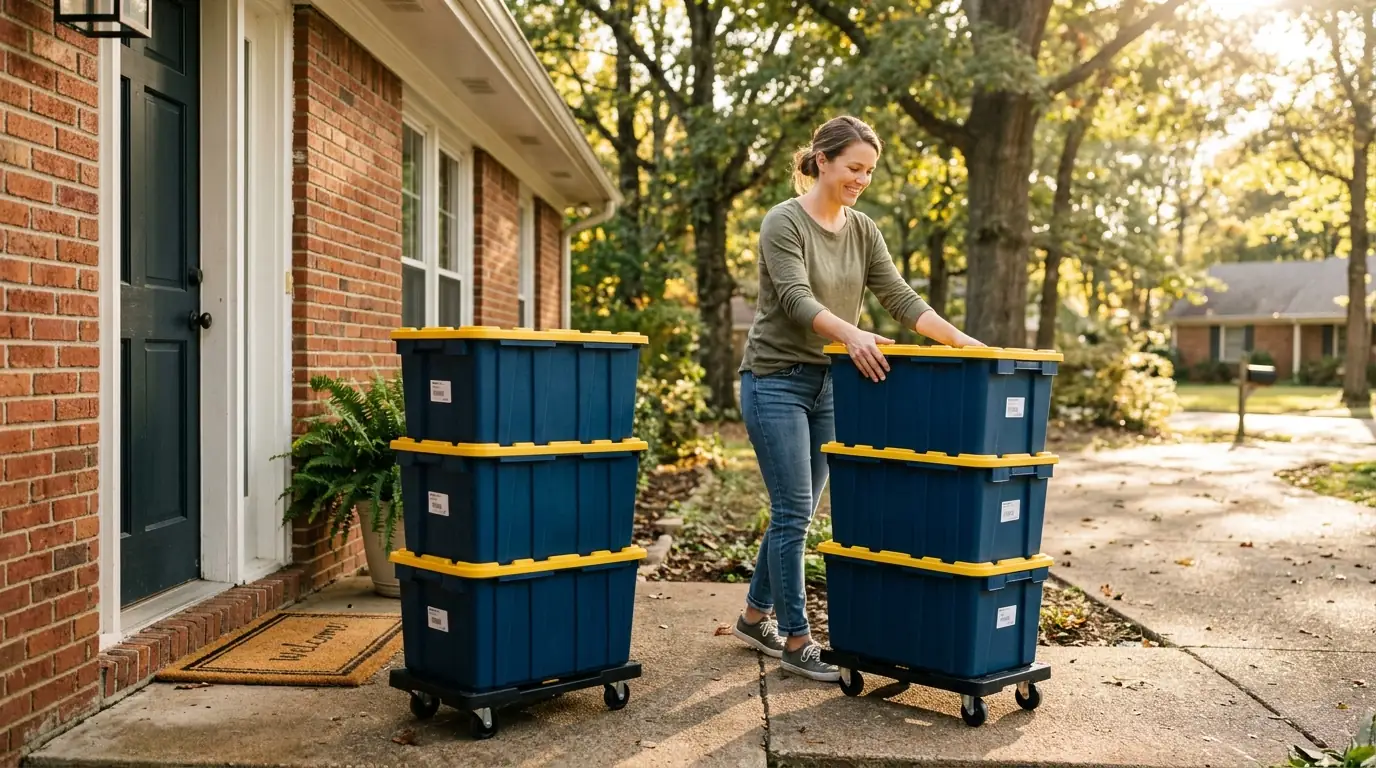
A moving-bin rental business rents clean, reusable plastic bins to people who are moving, in place of cardboard boxes. You deliver the bins and dollies before the move, pick them up afterwards, wash them and rent the same bins again. Deliveries and pickups are batched onto one or two route days a week.
How much does it cost to start a moving-bin rental business?
Mostly the bins. MoverBins pays about $16 a bin, so a starting fleet of 300 bins is roughly $4,800. Add a few dollies, labels and cleaning supplies, a vehicle you may already drive and a garage to store and wash in. RelayBins is $99 a month after a 14-day free trial.
| Item | What to plan for | Cost |
|---|---|---|
| Bins | A starting fleet of about 300, added to as bookings grow | About $16 each — roughly $4,800 for 300 |
| Dollies | A few per order; a 2 Bedroom order takes 3 | Varies by model |
| Vehicle | A cargo van, a pickup with a cover or a small trailer — often one you already drive | Often nothing new |
| Storage and washing | A garage is enough to begin, with room to wash and dry returned bins | Space you have, plus cleaning supplies |
| Labels and supplies | Bin labels, cleaning supplies, packing add-ons you sell | Small |
| Software | RelayBins: bookings, inventory, routes, payments, customers | $99 a month after 14 days free |
| Card processing | Your payment processor’s published rate, charged by them | Per payment, nothing added by us |
Bin cost is MoverBins’ own; your supplier’s price and the fleet size you start with will differ.
What do you need to start a bin-rental business?
Bins and dollies, a vehicle that carries a typical order, space to store and wash bins, and one or two days a week for the route. You also need prices and a way for customers to book and pay online, which is the part RelayBins handles.
- Bins with lids that nest when empty, and a few dollies
- A vehicle that carries a typical order
- Somewhere to store and wash bins between rentals
- One or two days a week for deliveries and pickups
- A price book: packages, add-ons and a fee for off-route days
- A way to take bookings and payments online
How do you start, step by step?
Check your market, buy a starting fleet, set your prices and route days, put booking online, run your first route day, then wash returned bins and put them back on sale. Start small from a garage, and grow the fleet once bookings fill the calendar.
- 1
Check your market
Every city has people moving every week. Look at who rents boxes and trucks near you, and pick the area you can cover in one route.
- 2
Buy a starting fleet
Start with what fits in your garage and vehicle — MoverBins’ figure is about 300 bins — and add more when the calendar fills.
- 3
Set prices and route days
Packages by home size, add-ons, extra weeks, and a fee for deliveries on a day that is not a route day.
- 4
Put booking online
Connect your own website to RelayBins with one key so it shows only the days you can serve — or apply to run as a MoverBins location.
- 5
Run your first route day
Deliveries and pickups in one loop. RelayBins lists the day’s stops in order, with the bins each one needs.
- 6
Wash and put bins back on sale
Returned bins are held through your turnaround days, then become available again.
How do route days and off-route (SOS) deliveries work?
Deliveries and pickups are batched onto one or more route weekdays — Thursday, at MoverBins — so the driving happens in one loop. A customer who needs bins on another day can book an SOS delivery for an extra fee, and pickups always land on a route day.
- Each route day has a cap on stops, so a full truck closes the day to new bookings
- Bookings only offer days with enough bins in stock through pickup and washing
What problems come up, and how are they handled?
The usual ones are double-booked bins, bins not washed in time, overloaded route days, unpaid balances and late returns. Most are solved by checking availability against every day of the rental, holding returned bins through washing, capping stops per day and saving the card at booking.
- Two customers booking the last bins
- RelayBins checks stock for every day from delivery through pickup and washing before it takes a booking, so the same bin cannot be promised twice.
- Bins not back and clean in time
- Returned bins are held through your turnaround days before they go back on sale, so availability already allows for washing.
- Too many stops on one day
- Each route day has a stop cap. When the truck is full, that day stops showing as available.
- Collecting the balance after the move
- The card is saved at booking, so the balance and any agreed fees are charged to it rather than chased.
- Late returns and extensionsRolling out
- Reminders, one-tap extensions and short-count or damage fees you approve are being built into RelayBins.
- Customers who default to cardboard
- The pitch is the difference: bins arrive at the door, need no tape, stack on a dolly and leave when the move is done.
Should you open a MoverBins location or start your own brand?
A MoverBins location runs under MoverBins’ name, look and playbook; it is by application, one operator per city. Your own brand means your name, prices and website, with RelayBins as the software underneath. Both run on the same platform, and you can apply and decide on the call.
| Compared | MoverBins location | Your own brand |
|---|---|---|
| Name and look | MoverBins’ name, look and launch playbook | Your own name and brand on everything customers see |
| Prices and service area | Set with help from MoverBins | Set by you, in your own price book |
| Booking website | Agreed when you apply | Yours — connected to RelayBins with one key |
| Software | RelayBins, included from day one | RelayBins, $99 a month after 14 days free |
| How to start | Apply; one operator per city | Apply, or start the free trial today |
| Terms | Shared once you apply | Month to month; cancel from the app |
How much can a moving-bin rental business make?
It depends on your prices, your market and how many rentals you run each month, so there is no honest single number. The earnings calculator uses MoverBins’ real prices and costs as defaults and lets you change every input; treat its result as arithmetic, not a promise of income.
More questions
How long is a typical bin rental?
MoverBins’ standard rental is two weeks: bins are delivered before the move and picked up about two weeks later, on a route day. Extra weeks are sold as an add-on.
How many bins does a typical order need?
At MoverBins a 2 Bedroom order is 35 bins and 3 dollies. Smaller and larger homes get their own packages, and customers can build a custom order.
Can I run a bin-rental business alongside a full-time job?
That is how it is designed to work. Deliveries and pickups are batched onto one or two route days a week, and bookings, payments and confirmations happen online in between.
What does RelayBins do in a bin-rental business?
RelayBins runs the back office: online booking with live bin and truck availability, inventory with wash turnaround, route days, payments into your own Stripe account, and a customer CRM with email and texting. It is $99 a month after a 14-day free trial.
Costs and the software’s price are covered in more detail on pricing, and the landing page answers what people ask before they start.
Ready to start in your city?
Apply as a MoverBins location, or start under your own brand today: $99 a month, 14 days free.
Prefer to talk first? Book a demo